Tuesday, August 12, 2014
Day 5 PART 2: DRAWWORKS
 |
| The Drawworks |
Next are the components on the rig floor starting with the noisiest part- the drawworks. It’s a JC-70D type and any one who did science in primary school would describe it as a large winch or drum with a large spool of drilling line wrapped around it. While standing close to it, you can easily understand how it works, driven by two massive DC motors each 800 kW via an air clutch and drive chain mechanism which you can hear whenever the driller activates control and releases the brake.
 |
| The leBus Grooves on the Drawworks and the Brake System on the right |
Even more amazing is the automatic reeling and unreeling of drilling line as the travelling block is raised and lowered-of course I could understand how the leBus grooving system does all this for even multiple rolls of the drilling line and it would still arrange it so neatly on the drum. The function of the drawworks is to deliver the drill bit to and from its area of operation and to transmit the loads to the rig structure. To enable this, the drilling line is attached to an anchor on the drum on which the wire is spooled, and the wire is fed from a storage spool that I could see on the ground just behind the rig….of course the spool contains enough wire to last for long because I don’t remember there being a shortage of drilling wire that necessitated any pulling in of more wire from the spool. The wire from the spool is fed to the DLA-Dead Line anchor, then to the “fast line” of the crown block at the top of the derrick where it goes through a series of pulley sheaves and down through the travelling block sheaves before passing back to the crown again and onto the drawworks drum and once enough wire is spooled around the system, the rest is securely clamped to the DLA. The “fast line” is subjected to most wear and it’s the one I concentrated on most while lubricating.
 |
| As we worked on chain repairs |
For its working, the drawworks has two DC motors fitted with toothed couplings connected to sprockets that use chains to drive even larger sprockets for more torque. The driven sprockets are bolted onto the drive shaft and do not rotate till the high or low gears are engaged when the driller selects the required clutch setting while raising the travelling block and drill string. Basically, normal operations involved engaging clutches and motors for any hoisting operation and disengaging to allow a free fall and braking to control gravity falling of loads. Of course I had learnt about the pneumatic clutches and this is the first place I saw it being applied…..ever heard of fawick pneumatic clutches…..same principle.
Day 5 PART 1 7/2/2014: The Substructure
 |
| The Substructure |
The next part we looked at was
the substructure and as Mr. Nyaga explained to me, I can just describe it as a
rugged system of beams….in this case, the whole of the green part that supports
the mast, the rig floor and provides a platform for installation of the other
mechanical and electrical systems that are on the floor. It must be high enough
just to accommodate the BOP stack below it. And while he was explaining this,
somebody came and tricked me at first that he was looking for a key to open the
V-door and they had to explain to me that the V-door is not really a door….that
sounds funny, its just a controlled access route used by crew members to hoist
pipe and equipment from the catwalk up the pipe ramp to the rig floor by
pulling using the air hoist…which I really liked to operate. I remember while
at Rig 4, I was nearly overpowered by a drill pipe while it was being raised
and I had to trap it with a piece of rope but thanks to the unity of fellow
crew members at GDC, the helped me to do it safely.
The exact type of substructure is
a DZ450 that puts the drilling floor at about 10.5 m.


Day 4: 6/2/2014 Rig Orientation at GDC Rig 2-The mast
Of course I know that you too
would like to know parts of the rig. In this case, when I asked, I was told
that the drilling rigs at GDC are all from China, model type ZJ70D. The ZJ70D
is an SCR DC driven drilling rig with a maximum depth of 7 km. However, after
staying here for sometime I came to a conclusion that it the hardware is
china-made, but the brains are purely German technology.
 |
| The Mast |
Right off by just looking at the
rig I was shown the mast and derrick assembly. This will be what you see first
whenever you see a rig from far. I overheard some new guys who had never seen
it before asking what kind of “booster” that was….ha ha ha. The mast is a
strong massive tower that supports other equipment like the travelling block
and the hook. The mast stands independently on the rig floor and is a welded
structure tall enough to allow the drilling crew to set up the drill pipes and
other tubulars like drill collars during a trip out. It also has to be tall
enough to allow the driller to raise the travelling block above the monkey
board so that the derrick man can dislodge and lodge on pipes during POOH and
tripping in respectively.
 |
| The A-frame |
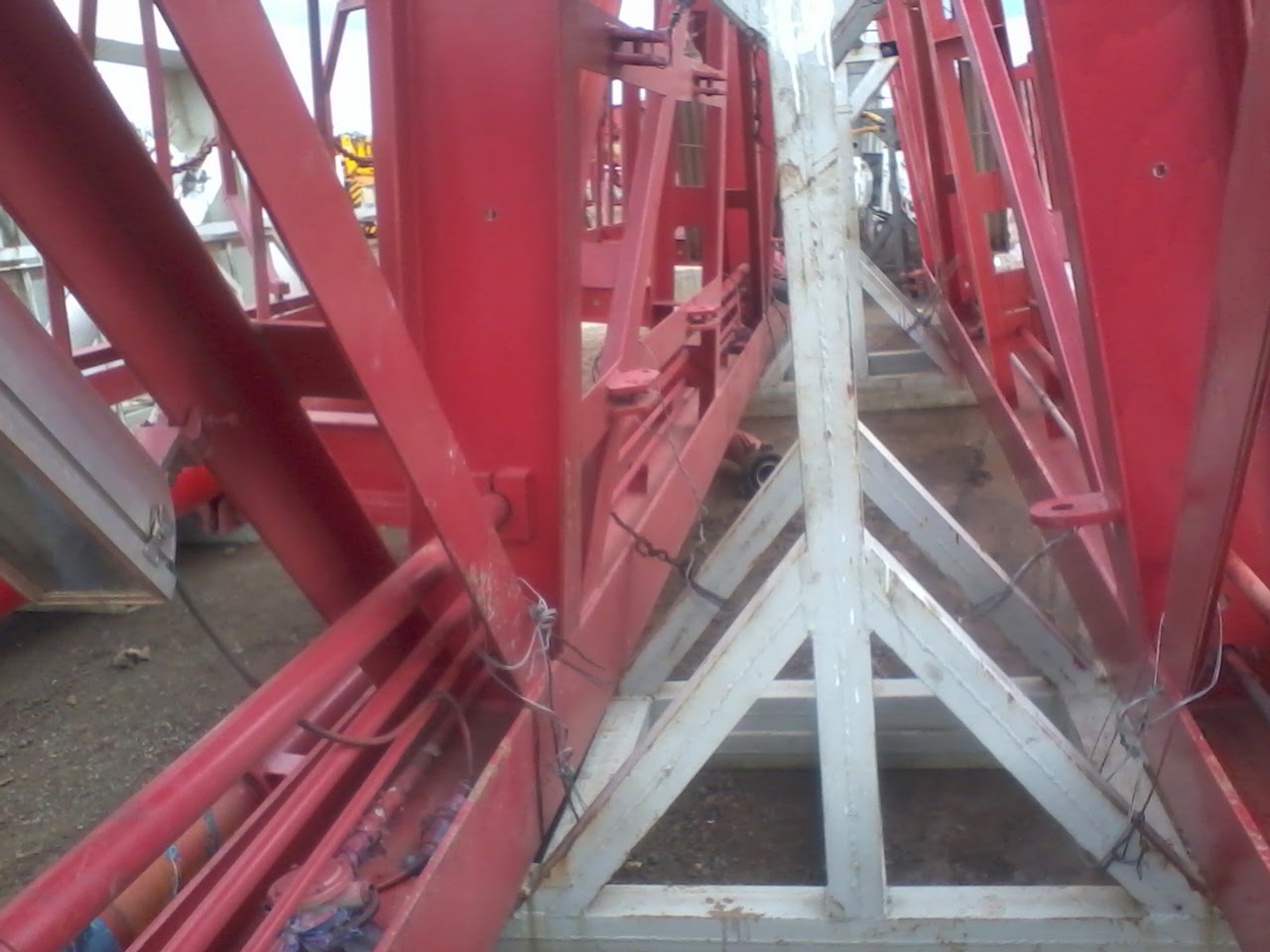 |
| The mast before being carried away |
The mast on the ZJ70D is the
JJ450-5 type which supports a maximum swivel load of 4500 kN and extends to
45.5 m. It is equipped with a step wise climbing mechanism surrounded by a
casing like anti drop mesh of rails for safety and also has many attachments to
hold the slings for the safety gear.
I do remember very well my last
moment at GDC Rig 4 where we were pulling out 3 joint stands of drill pipes in
the rain and arranging them on the floor held by fingers, while tripping out,
so as to change the drill bit. Tripping
pipe in stands is much faster as it helps hasten the tripping process.
Those of us who do not know the
monkey board-is the platform up on the mast where the derrick man works. The
walkaround or watertable is the platform that permits access to the crown block
at the top of the mast. The crown block is the uppermost system of pulleys
where the drilling wire passes and I remember going there once to grease……very
epic experience. The safety at GDC is very paramount as policies are in place
to ensure no one is injured. Use of safety gear for all height operations is
mandatory and the drilling supervisor and your fellow team members have a
responsibility to follow up and ensure you are safe.
Day 3 5/2/2014
I know am supposed to take you
through my day three but before that…..today I just did my CAT 1 on Computer
Controlled Manufacturing (CCM). I had a rather smooth time explaining the use
of pneumatic valves in speed control especially thanks to the knowledge passed
to me by Mr. Nyaga, one of the best technicians at GDC Rig 2 who gave me a lot
of hands-on knowledge on Rig Mechanical systems from hydraulic, pneumatic and
Structural Mechanics…..very beneficial information that I bet I would not have
found anywhere. And how is speed control applied on pneumatic systems on the
Rig?
The pneumatic system does the
braking of the drawworks while doing POOH and RIH operations
both automatically using the two protective limit and safety devices,
and by the driller applying brakes. The whole system is pneumatically activated
and I remember interpreting the circuits at the Maintenance Cabin, Wow!
Ok, this is not the day for this,
On day three was arrival day at the field, Menengai. Here comes the good
part…..our Van. I do appreciate on behalf of my fellow interns, the transport
that the company gave us. This was the best part of this hospitality at GDC, a
company van with a designated driver just for the attachees was just awesome.
We really appreciate Godana, our driver from day 1, for being very kind
accepting the challenge despite the fact that he had other errands to run, like
being the Head of Camp at Menengai. So, to cut it short, he picked us up at 7am
from Generation house parking to Menengai, more specifically dropped us at Rig
2 on his way to the camp.
On this day, we were all new and
knew nothing about drilling Rigs and so we asked many questions as we drove
past Kabarak, into Menengai, Barrier and even had more questions when we saw
the “booster-like” things for the first time. We went past Rig 1 and could see
Rig 3, Rig 4 before we alighted at Rig 2 and were handed over to Mr. Too, the Rig
2 Maintenance Engineer. Of course I had done a bit of research and watched as
many videos as possible about drilling rigs and so I was the one helping answer
some questions that I could while Mr. Nyaga helped us understand more.

So, on being welcome here, we
just got to work. Rig 2 was on Rig down, i.e being dismantled in readiness to
be transported to another site that was being prepared. Wow, Mr. Nyaga told us
that we were the luckiest attachees because we would gain maximum experience as
we would see every part of the Rig and this didn't make sense till later….we
really learnt a lot.
So Mr. Too gave us our first
task, stating clearly off course that at the Rig we would learn more by
experience and doing a lot rather than just watching people do things so we
were greatly encouraged. Our task for most of that day was transferring items
from a KOOMEY to a store cabin for better storage and arrangement. Some of the
items we transferred included Generator and Compressor filters for oil and
fuel, Valves and transducers mostly
Rexroth Control valves…yeah German Technology running Chinese Rigs; Motors etc.
 |
| The SKF induction heater |
I remember transferring this SKF
induction heater from the KOOMEY to the store. You may be wondering just what
this is…..it’s used to insert bearings for example where the bearing is
supposed to have a tight fit so its slightly smaller, so you use this heater to
expand it a bit before you do the fitting.
We all did some good teamwork
here and all parts were well arranged in the store. Unfortunately, it was too
late for this day and as we slowly took our 4 o’clock tea which I still miss
till today, we got to know even more people at the rig as we waited for Godana
to pick us.
Mr. Nyaga promised to do a proper
orientation for us on the next day and as we left for Nakuru town, we looked
forward to the next day with a lot of enthusiasm.
Thursday, July 10, 2014
Day 2: 5/2/2014
On the next day, as obedient as I have always been, I
reported at the Polo house GDC (Geothermal Development Company) office at 8am, ready with my PPE’s. I got to
know my other attachees apart from my classmate, there was Patrick, Nashilobe
and Njoroge….hence the short forms Pato, Nash and Njoro. We were then referred
to Generation House that housed the Drilling Operations department. There we
met Mr. Stephen Kangogo, the Chief Drilling Engineer and yes am always amazed
by this simple kind man, not just because he also did his Engineering at JKUAT
like me, but also due to his understanding approach to issues.
He welcomed us for a cup of tea as he planned for some
logistics to ensure our learning process was in place. As we finished our cup
of tea, we caught a first glimpse of drilling operations at GDC (Geothermal Development Company) through a
management meeting that was just organized int the same room we took our tea
just as we were leaving the room. There were a few presentations set up and
though we could not understand much at that time, we saw something to do with
well progress….anyway, not important for this context.
To our disappointment, Mr. Kangogo called us back to his
office and humbly requested us to come on the next day as the logistics were
not yet complete for our integration into the field. So we left with our “new”
friends and decide that since we were new in town we would walk around till we
were tired and then take a nap to prepare for the next day because just as we
were leaving, we met Mr. Koloi who really talked to us in detail about how good
life was at GDC (Geothermal Development Company) and emphasized on how much work there was especially in the
field at Menengai.
This meant that it was one of our free days in Nakuru so we
really went out and had fun so that when we start going to Menengai we would
not regret it….consolation my friend.
Till Day 1 : Reporting on 4/2/2014 and how it goes.
Five of us were picked from two universities, two from
Mechatronic Engineering department at JKUAT (including myself), and three from
Mechanical Engineering department of Kimathi University. We were called on
phone on 30th January 2014 by the HR Mrs Moraa and told to give our
email address that had to be used to send us our offer letters.
So I gave my email address via text and the offer letter was
sent. The main emphasis in it was the PPE’s that were required. Otherwise, the
HR officer told us to report at Polo house in Nakuru on Monday 3rd
February 2014. I and my friend Justus went to Nakuru that Monday and were
welcomed well and told to sit in the waiting room till we are called because
there was another ongoing interview. Of course we did interact with the
mechanic interviewees in the waiting room as they did their final preparations
before they got into the interview room.
What I learnt from here was that GDC (Geothermal Development Company) has a good community
policy that ensures some jobs are given to locals in a rotational contract
manner so that the cake is at least equitably shared among the youth. I always
laugh about it when I remember how tensed some of them were in the waiting room
compared to how lively they were in the field because I got to meet some of
them later in the field at Menengai and they are simply different.
Later in the afternoon, we were called by the HR officer who
confirmed our PPE’s were in order then told us to come on the next day so that
she could hand us over to the drilling department as stated in our offer
letters.
I cannot skip this 4pm moment when I felt really new in a
town I had never stayed other than just seeing it on my way from Lugari to
Nairobi. By good luck and a bit of thanks to my kind approaches I met a cleaner
who lived around and explained to him that I was new to Nakuru and could not
know where I could find accommodation.
So he accepted to take me around and show me some of the
good hostel where I could find accommodation and so down we walked from Polo
center towards MKU, past Evans Hospital and finally I found myself asking for a
room at Norraine Paradise hostels. I found the rates a bit favorable, meals and
accommodation for 5500/= per month, not a bad deal. I talked to my very
supportive parents and the accommodation issue was sorted once and for all. I
proceeded to my room and was set up for the internship, a visit to the
supermarket that evening to get a few basic items and I was settled.
Something I found strange about the hostel was the “Panga
bell” that rung just as I coming from the supermarket and it sounded weird
because it gave me that Maseno School impression….and the thought that I would
have to put up with this for a whole three months? Ha ha ha.
The Preamble
 |
| I and Patrick at GDC |
It’s on our industrial trip at Sameer Africa on June 26th, 2014 and I still stand out with my “very old” overall that I kept after my
attachment at GDC (Geothermal Development Company) just to reminding me of my beautiful moments at the company. My
friend Justus with whom we were with on attachment at GDC (Geothermal Development Company) had thrown away his
overall which really shows how bad of a state it was. I am always proud telling
others am the more experienced student engineer just because the overall tells
it all…..like being through the ringer, something close to that and I liked
it….just proud. I still stand up for my statement that GDC (Geothermal Development Company) is the best Drilling
Company in Africa, not because I was there for my final attachment but because
of the organized operations I was part of for those three months.
Which sane person stays on unpaid attachment for three
months? This is one of the rude claims I could make before I joined the company
for attachment in February 2014. I thought like,”Since this attachment is
unpaid, I will stay for three months just to fulfill my department requirements
and then I will be gone!” Ha ha….What happened? This is the journey I will be
taking you through this blog “The memoirs of a GDC (Geothermal Development Company) intern”.
Subscribe to:
Posts (Atom)